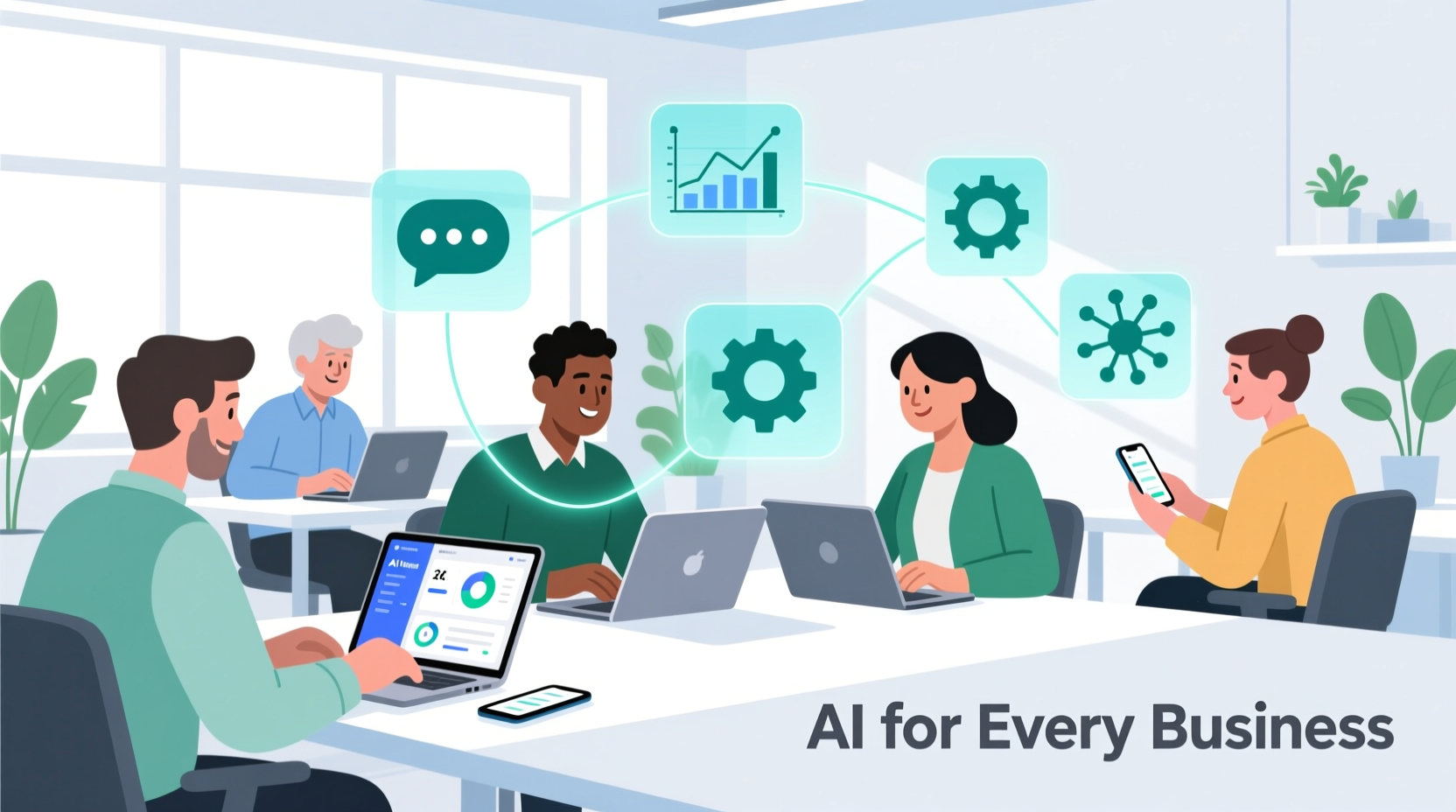
Artificial intelligence has evolved from an enterprise-exclusive technology into an accessible powerhouse for businesses of all sizes. Small businesses, often operating with limited budgets and lean teams, now have unprecedented opportunities to compete with larger competitors by strategically implementing affordable AI solutions. This comprehensive guide explores practical ways to harness AI's potential without straining your financial resources.
Understanding the AI Advantage for Small Businesses
The democratization of AI technology has fundamentally changed the business landscape. What once required substantial capital investment and technical expertise is now available through user-friendly platforms with flexible pricing models. Small businesses can automate repetitive tasks, gain valuable customer insights, enhance marketing efforts, and improve operational efficiency—all while keeping costs manageable.
The key lies not in adopting every available AI tool, but in identifying which solutions deliver the highest return on investment for your specific business needs. By focusing on high-impact, budget-friendly options, small businesses can achieve transformative results without the enterprise-level price tag.
Free and Low-Cost AI Tools Worth Exploring
Customer Service and Communication
AI-powered chatbots have revolutionized customer service accessibility. Platforms like Tidio, ManyChat, and Chatfuel offer free tiers that allow small businesses to provide 24/7 customer support without hiring additional staff. These tools can handle common inquiries, qualify leads, and escalate complex issues to human team members when necessary.
For email management, tools such as Gmail's Smart Compose and Reply features leverage AI to help you respond faster and more professionally. These capabilities are built into existing platforms you likely already use, making them completely free additions to your workflow.
Content Creation and Marketing
Content marketing demands significant time investment, but AI writing assistants can dramatically accelerate the process. Tools like ChatGPT, Claude, and Google's Gemini offer free tiers that help generate blog post outlines, social media content, email campaigns, and product descriptions. While human oversight remains essential for quality and brand voice, these tools can reduce content creation time by up to 70%.
Canva's AI-powered design features enable non-designers to create professional-looking graphics, presentations, and marketing materials. The free version includes substantial AI functionality, from background removal to design suggestions, making professional visual content accessible to businesses without dedicated design teams.
For social media management, tools like Buffer and Hootsuite incorporate AI features in their affordable plans to optimize posting times, suggest content improvements, and analyze engagement patterns. This intelligence helps maximize your social media ROI without requiring expensive marketing agencies.
Business Analytics and Insights
Google Analytics 4 incorporates machine learning to provide predictive insights about customer behavior, conversion probabilities, and revenue forecasts—completely free for small businesses. These analytics help you make data-driven decisions about where to focus your marketing efforts and budget.
Microsoft Excel and Google Sheets now include AI-powered features like pattern recognition, automated insights, and intelligent data suggestions. These built-in capabilities help small business owners identify trends and make informed decisions without investing in expensive business intelligence software.
Administrative Automation
Calendar scheduling tools like Calendly and Doodle use AI to eliminate the back-and-forth of meeting coordination. The free versions handle most small business needs, saving hours each week that can be redirected toward revenue-generating activities.
Accounting platforms such as Wave offer free AI-enhanced bookkeeping that automatically categorizes transactions, generates financial reports, and tracks expenses. This automation reduces the time spent on administrative tasks and minimizes costly errors.
Strategic Implementation: Getting Maximum Value
Start With Your Biggest Pain Points
Rather than implementing AI tools across all operations simultaneously, identify the areas where manual work consumes the most time or where errors are most costly. This focused approach ensures that your initial AI investments deliver immediate, measurable value.
Common high-impact starting points include customer inquiry management, appointment scheduling, invoice processing, social media posting, and basic data entry. Automating these tasks frees your team to focus on activities that directly drive revenue and customer satisfaction.
Leverage Free Trials Strategically
Most premium AI tools offer free trials ranging from 7 to 30 days. Use this period strategically by preparing specific use cases and success metrics before activating the trial. This focused testing helps you determine whether a paid subscription genuinely delivers value or if a free alternative suffices.
Create a simple evaluation framework that considers time saved, quality improvements, ease of use, and integration capabilities. Document your findings to make informed decisions when trials expire.
Integrate AI With Existing Systems
The most cost-effective AI implementations work seamlessly with your current technology stack. Before adopting new tools, verify they integrate with your existing CRM, email platform, accounting software, or e-commerce system. This compatibility prevents the need for costly data migration or duplicate systems.
Many affordable AI tools offer native integrations with popular platforms like Shopify, WordPress, Salesforce, QuickBooks, and Mailchimp. These connections create automated workflows that amplify efficiency without requiring technical expertise or additional investment.
Building AI Skills Within Your Team
Accessible Learning Resources
Your team doesn't need computer science degrees to leverage AI effectively. Numerous free resources help small business owners and employees develop practical AI literacy. Platforms like Coursera, LinkedIn Learning, and YouTube offer courses specifically designed for business applications rather than technical development.
Google, Microsoft, and HubSpot Academy provide free certification programs covering AI fundamentals, prompt engineering, and business strategy. These programs typically require just a few hours to complete and immediately apply to real-world business scenarios.
Prompt Engineering Basics
Getting the best results from AI tools, particularly generative AI assistants, requires effective communication through well-crafted prompts. Learning basic prompt engineering—how to clearly articulate what you need from AI—dramatically improves output quality and reduces time spent refining results.
Simple principles like providing context, specifying desired format, including relevant examples, and iterating based on results can transform mediocre AI outputs into highly useful business assets. This skill costs nothing but attention and practice.
Foster an Experimentation Culture
Encourage team members to explore AI tools relevant to their roles without fear of failure. Create a shared document where employees can recommend tools, share prompts that work well, and document time savings. This collaborative approach distributes the learning burden and accelerates organization-wide AI adoption.
Allocate a small amount of time each week for "AI experimentation hours" where team members can test new tools or develop better workflows with existing ones. The insights gained from this dedicated exploration time often yield substantial productivity gains.
Cost-Benefit Analysis: Measuring AI ROI
Track Time Savings
The most immediate benefit of AI tools is time reclaimed from repetitive tasks. Implement simple tracking mechanisms to measure how many hours AI tools save weekly. Multiply these hours by your team's hourly rate to calculate hard dollar savings.
For example, if an AI chatbot handles 100 customer inquiries monthly that previously required 15 minutes each, that's 25 hours saved. At a customer service representative rate of $20 per hour, that represents $500 in monthly savings—easily justifying a modest subscription fee.
Monitor Quality Improvements
AI tools often improve output quality alongside efficiency. Track metrics like customer satisfaction scores, error rates in invoicing or data entry, engagement rates on AI-assisted content, and conversion rates from AI-optimized marketing. These quality improvements often deliver value exceeding direct time savings.
Calculate Opportunity Costs
Consider what your team can accomplish with reclaimed time. If AI tools free up 10 hours weekly that can be redirected toward sales activities, business development, or strategic planning, the indirect value often far exceeds the tool's direct cost.
Common Pitfalls to Avoid
Over-Automation Too Quickly
While enthusiasm for efficiency is understandable, automating too many processes simultaneously creates confusion and increases error risk. Implement AI solutions incrementally, ensuring each new tool is fully integrated and understood before adding another layer of automation.
Maintain human oversight for customer-facing communications and critical business decisions. AI should augment human judgment, not replace it entirely, particularly in small businesses where personal relationships drive customer loyalty.
Neglecting Data Privacy and Security
Free and low-cost AI tools often monetize by collecting user data. Read privacy policies carefully, particularly when processing customer information. Ensure any AI tool you adopt complies with relevant regulations like GDPR or CCPA if you serve customers in those jurisdictions.
For sensitive business information, consider whether cloud-based AI processing creates unacceptable risk. Some operations may warrant keeping data on-premises or using privacy-focused alternatives, even if they cost slightly more.
Ignoring the Human Touch
AI excels at efficiency but lacks genuine empathy, creativity, and relationship-building capabilities. Small businesses often compete on personal service and community connection—attributes that AI cannot replicate. Use AI to handle routine tasks so your team has more capacity for meaningful customer interactions.
Clearly disclose when customers are interacting with AI systems, and always provide easy paths to human assistance. Transparency builds trust, while hidden automation can damage customer relationships when it inevitably mishandles nuanced situations.
Industry-Specific AI Applications
Retail and E-Commerce
Small retailers can leverage AI for inventory forecasting, personalized product recommendations, dynamic pricing optimization, and automated customer segmentation. Shopify, WooCommerce, and BigCommerce all include AI features in their standard plans, making these capabilities accessible without additional investment.
AI-powered visual search tools help customers find products using images rather than keywords, while virtual try-on features reduce return rates. These technologies, once exclusive to major retailers, are now available through affordable plugins and integrations.
Professional Services
Law firms, accounting practices, consultancies, and agencies can use AI for document analysis, research assistance, client communication management, and project scoping. Tools like Notion AI and Coda incorporate AI features into collaborative workspaces, helping small professional services teams work more efficiently.
Transcription services with AI-powered summarization like Otter.ai or Fireflies.ai automatically document meetings and extract action items, ensuring nothing falls through the cracks while saving hours of manual note-taking.
Healthcare and Wellness
Medical practices and wellness providers can implement AI scheduling systems that reduce no-shows through intelligent reminders, optimize appointment spacing, and handle routine inquiries about hours, services, and insurance. Telehealth platforms increasingly incorporate AI triage to help patients reach appropriate care levels.
Practice management systems now include AI features for billing optimization, claim submission accuracy, and patient communication—all within affordable monthly subscriptions designed for small practices.
Food Service and Hospitality
Restaurants and hotels can leverage AI for demand forecasting, dynamic menu pricing, inventory management, and reservation optimization. Platforms like Toast and OpenTable incorporate AI capabilities into their standard offerings, helping small establishments compete with larger chains.
AI-powered review monitoring and response tools help manage online reputation across platforms like Google, Yelp, and TripAdvisor, ensuring consistent engagement without overwhelming small teams.
Looking Ahead: Future-Proofing Your Business
Stay Informed About AI Developments
The AI landscape evolves rapidly, with new capabilities and pricing models emerging regularly. Dedicate time monthly to review AI news relevant to your industry. Subscribe to newsletters from AI providers and small business associations to stay informed about new opportunities.
Participate in online communities and local business groups where peers share AI implementation experiences. These networks provide practical insights and help you avoid costly mistakes others have already navigated.
Build Scalable Systems
As your business grows, your AI needs will evolve. Choose tools that offer clear upgrade paths rather than those requiring complete platform changes as you scale. Starting with providers that serve businesses from startup to enterprise stages—like HubSpot, Salesforce, or Microsoft—provides continuity even as your needs expand.
Design workflows that can accommodate both AI and human execution, allowing you to adjust the balance as technology improves or business circumstances change. This flexibility ensures you're not locked into specific tools or approaches.
Maintain the Human Core
Technology serves business objectives—never the reverse. Regularly evaluate whether your AI implementations genuinely improve customer experience and employee satisfaction. If automation creates frustration or diminishes service quality, scale it back regardless of efficiency metrics.
The most successful small businesses use AI to amplify their unique human qualities: creativity, empathy, local knowledge, and personal relationships. Technology should free you to do more of what makes your business special, not replace those distinctive characteristics.
Conclusion
Small businesses no longer face an impossible choice between AI-powered efficiency and budget constraints. The current landscape offers remarkable tools at price points ranging from free to remarkably affordable, creating genuine opportunities for competitive advantage without significant capital requirements.
Success lies not in adopting the most advanced AI available, but in strategically implementing solutions that address your specific challenges and integrate seamlessly with your existing operations. Start small, measure results carefully, learn continuously, and scale what works. This disciplined approach allows you to harness AI's transformative potential while maintaining the financial prudence essential for small business sustainability.
The businesses that thrive in coming years will be those that thoughtfully blend artificial intelligence with authentic human expertise—using technology to amplify their strengths rather than replace them. With the right approach, AI becomes not an expensive luxury but an accessible tool for building more efficient, competitive, and ultimately more successful small businesses.
FAQs
What are the best free AI tools for small businesses starting out?
Small businesses just beginning their AI journey should start with ChatGPT or Claude for content creation and customer communication, Google Analytics 4 for website insights, Canva's free AI design features for marketing materials, and built-in AI features in Gmail for email management. These tools require no financial investment and provide immediate value across multiple business functions. Additionally, platforms like Tidio offer free chatbot services that can handle basic customer inquiries 24/7, making them excellent starting points for businesses with limited budgets.
How much time can AI tools realistically save my small business?
Time savings vary depending on the specific tools and processes you automate, but most small businesses report saving 10-20 hours per week after implementing even basic AI solutions. Customer service chatbots typically handle 60-80% of routine inquiries without human intervention, while AI writing assistants can reduce content creation time by 50-70%. Administrative automation tools for scheduling, invoicing, and data entry often save 5-10 hours weekly per employee. The key is starting with your most time-consuming repetitive tasks to maximize initial impact.
Do I need technical expertise to implement AI tools in my business?
No, most modern AI tools are specifically designed for non-technical users with intuitive interfaces and simple setup processes. The current generation of business AI tools operates through user-friendly dashboards, pre-built templates, and guided workflows that require no coding knowledge. Many providers offer free tutorials, customer support, and implementation guides to help you get started. Basic computer literacy and willingness to learn are typically sufficient. For more complex integrations, many affordable AI platforms offer implementation assistance or connect you with certified consultants at reasonable rates.
How do I measure if an AI tool is actually worth the investment?
Measure AI tool value through three key metrics: time savings, quality improvements, and revenue impact. Track hours saved on specific tasks before and after implementation, calculate the dollar value using your team's hourly rates, and compare this against the tool's cost. Monitor quality indicators like customer satisfaction scores, error rates, and engagement metrics to assess improvements. Finally, evaluate whether freed-up time enables revenue-generating activities like additional sales calls, product development, or strategic planning. If combined savings and value creation exceed the tool's cost by at least 3-5 times, it's typically worth maintaining.
Can AI tools replace human employees in my small business?
AI tools should augment human employees rather than replace them, especially in small businesses where personal relationships and creativity drive success. AI excels at handling repetitive tasks, processing large data sets, and providing 24/7 availability for routine functions, but lacks human judgment, empathy, creativity, and relationship-building capabilities. The most effective approach uses AI to eliminate tedious work, allowing your team to focus on high-value activities that require uniquely human skills like complex problem-solving, strategic thinking, and personalized customer care. Think of AI as a productivity multiplier for your existing team rather than a replacement strategy.
What security concerns should I consider when using AI tools?
When selecting AI tools, prioritize providers with clear privacy policies, strong data encryption, and compliance with relevant regulations like GDPR or CCPA. Avoid inputting sensitive customer information, financial data, or proprietary business information into free AI tools that may use your data for training purposes. Read terms of service carefully to understand data retention policies and third-party sharing practices. For sensitive operations, consider paid tools with enterprise-level security features, data processing agreements, and guaranteed data deletion policies. Always maintain backup systems and human oversight for critical business functions, and educate your team about safe AI usage practices to prevent accidental data exposure.